
This 27 year old man came to the Charlotte Gynecomastia Center with a concern that often frustrates physically fit patients. Despite having a well developed chest and visible muscle definition, his chest did not look masculine.
The issue was not lack of training or excess body fat. Beneath the nipple area sat a firm mass of breast tissue that disrupted the natural shape of his chest. From the front, the nipples appeared prominent. From the side, the chest had a rounded contour that contradicted his underlying muscle tone.
He was confident in his fitness level, yet the chest appearance did not reflect the work he had put into his body.

Understanding Glandular Gynecomastia in Fit Men
Gynecomastia in physically fit men often behaves differently than weight related chest fullness. In this case, the breast tissue was dense, firm, and glandular rather than fatty.
The tissue had a hard, white, scar like quality. It sat directly over a well defined pectoralis muscle, masking the natural borders of the chest rather than replacing them.
This type of gynecomastia does not respond to diet, exercise, or fat loss. In fact, building muscle can make the problem more noticeable by pushing the glandular tissue forward.
Chest Anatomy and Why Nipple Position Matters
A key anatomical feature in this case was the position of the inferior border of the pectoralis muscle. In this patient, the lower edge of the chest muscle sat below the nipple, which is considered ideal for defining a masculine chest.
When glandular tissue occupies the space over this muscle, it obscures that definition and forces the nipple into a more central and projected position.
By removing the gland, the nipple is able to settle naturally along the lateral inferior border of the chest muscle, where it belongs.
Surgical Goals and Strategy
The goal of surgery was not to sculpt or reshape the chest artificially. The goal was to uncover the chest shape that was already present.
Key objectives included:
- Complete removal of glandular breast tissue
- Preservation of surrounding fat for smooth contour
- Avoiding over resection
- Allowing the muscle anatomy to define the final shape
Since the issue was isolated to glandular tissue, liposuction played a minimal role. Precision excision was the focus.
Removal of Dense Breast Tissue
Through a discreet incision placed along the areolar border, the glandular tissue was accessed and carefully removed. A total of 91 grams of dense breast tissue was excised.
The tissue had the characteristic firmness and appearance seen in long standing glandular gynecomastia. Once removed, the underlying muscle contour became immediately apparent.
Care was taken to leave an appropriate thickness beneath the nipple to prevent indentation while still eliminating projection.

Immediate Change in Chest Contour
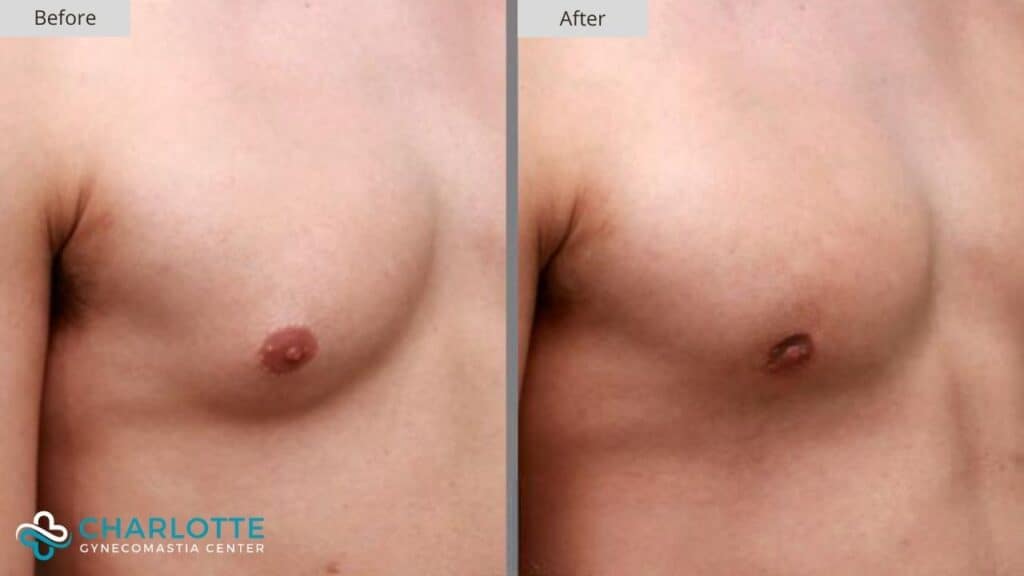
One of the most striking aspects of this case was how quickly the chest shape changed once the gland was removed. The rounded appearance resolved, and the chest assumed a flatter, more angular contour.
The nipple no longer projected forward. Instead, it rested naturally against the chest wall, aligned with the muscle border beneath it.
This immediate transformation is typical when dense glandular tissue is the sole cause of gynecomastia.
Healing and Scar Appearance
Healing progressed in a straightforward manner. Swelling gradually subsided, allowing the final contour to become more visible.
The incision was hidden along the edge of the areola, where changes in skin tone naturally conceal scars. Over time, the incision blended further into the surrounding tissue.
There were no long incisions across the chest and no disruption to muscle structure.
Viewing the Result From Multiple Angles
The before and after images include front and oblique views, demonstrating how the correction holds up from different perspectives.
From the front, the chest appears symmetrical and defined. From the side, the nipple projection seen before surgery is no longer present. The chest transitions smoothly from upper muscle to lower torso.
The result reflects the patient’s natural anatomy rather than a surgically altered appearance.
Permanence of Glandular Excision
An important aspect of this case is the permanence of the result. All glandular breast tissue was removed.
Once glandular tissue is excised, it does not grow back. As long as there is no new hormonal stimulation, the correction is durable and lasting.
This gives patients confidence that the improvement they see is not temporary.
When Surgery Simply Reveals What Was Already There
This case demonstrates that gynecomastia surgery is not always about creating something new. In many patients, especially those who are fit, the ideal chest shape already exists beneath the surface.
By removing the tissue that does not belong, the natural anatomy is revealed. The chest muscle defines the contour. The nipple settles into its proper position. The chest finally looks the way it should.
A Masculine Chest Defined by Anatomy
For this 27 year old man, the solution was direct and precise. Dense glandular tissue was the only barrier between him and a naturally masculine chest.
Once that tissue was removed, the chest assumed an athletic contour that matched his build and fitness level. The result is permanent, balanced, and anatomically appropriate.
This case highlights how understanding chest anatomy and selecting the correct surgical approach can produce results that feel effortless, because they simply restore what should have been visible all along.