
This 32 year old former Division 1 football player and competitive bodybuilder came to the Charlotte Gynecomastia Center with a concern that dated back to puberty. Despite his size, strength, and athletic background, he had lived with gynecomastia for most of his life.
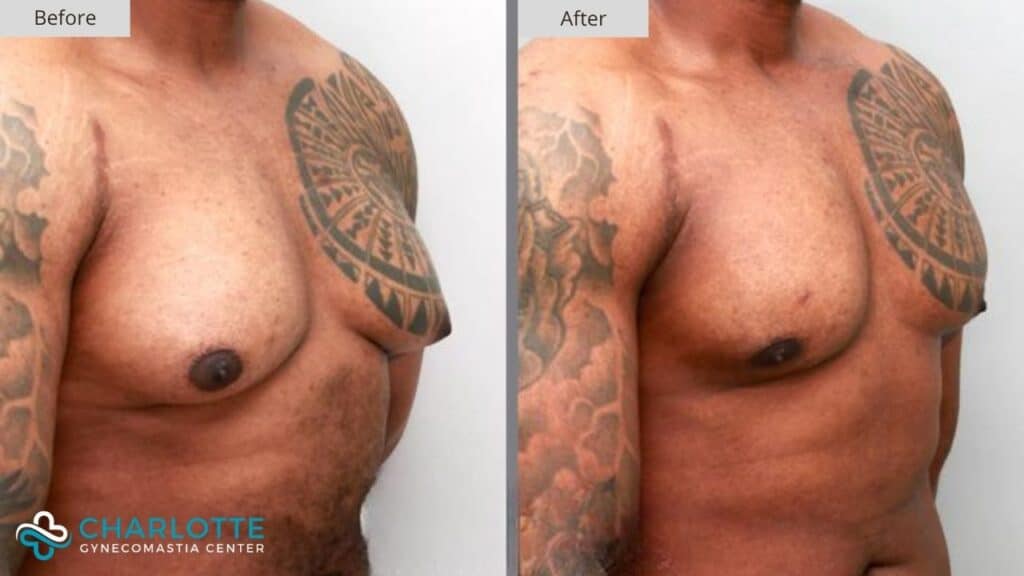
At six feet tall and weighing 269 pounds at the time of surgery, he had an imposing physical presence. However, his chest shape did not reflect the rest of his physique. The lower chest and nipple area had a pointed, rounded appearance that appeared feminine rather than muscular.
Ironically, years of intense weight training made the problem more noticeable. As his pectoral muscles grew, the glandular tissue beneath the nipples became more pronounced. Instead of flattening the chest, lifting weights exaggerated the contour irregularity.
Even as an experienced athlete, he avoided certain gym settings and fitted clothing. The disconnect between his physical capability and chest appearance affected confidence in ways that were not obvious to others but very real to him.
Why Gynecomastia Can Persist in Muscular Men
Gynecomastia is often misunderstood as a condition related to weight or fitness level. In reality, glandular breast tissue does not respond to diet or exercise. In muscular men, the contrast between a developed chest muscle and overlying gland can make the condition more visible.
In this patient, long standing pubertal gynecomastia remained despite years of training. The nipple area projected outward, creating a pointed contour that disrupted the natural masculine chest shape.
Due to his muscle mass, precise surgical planning was essential. Removing too little tissue would leave persistent fullness. Removing too much could risk contour deformity or skin laxity.
Surgical Goals and Planning
The primary objective was to restore a natural, masculine chest contour that aligned with his athletic build. The focus was not to create an exaggerated or artificial appearance, but to allow his underlying muscle structure to define the chest naturally.
Key goals included:
- Eliminating the pointed nipple contour
- Flattening the lower chest without hollowing
- Preserving muscle definition
- Addressing concerns about loose chest skin
Because of his concern about skin laxity after tissue removal, Renuvion skin tightening was incorporated into the surgical plan.
The Combined Surgical Approach
This procedure combined three complementary techniques to achieve the desired result.
Liposuction was used to remove fatty breast tissue and contour the chest smoothly. A total of 500 cc of fatty tissue was removed, allowing the chest to taper naturally into the surrounding torso.
Direct gland excision addressed the dense glandular tissue responsible for the nipple projection. 48 grams of glandular tissue were removed to eliminate the firm core that caused the feminine shape.
Renuvion was then applied to tighten the chest skin internally. This technology contracts the tissue beneath the skin, helping it conform to the newly contoured chest without requiring additional incisions.
All components worked together to reshape the chest while minimizing visible scarring.
Awake Surgery and Immediate Recovery
The procedure was performed under awake anesthesia, allowing for a faster recovery and reduced systemic impact. The total surgical time was approximately one hour and forty minutes.
Following surgery, the patient was able to stand, walk, and drive himself home the same day. This approach is particularly valuable for active individuals who prefer a quicker return to daily routines.
Early Results and Continued Physical Changes
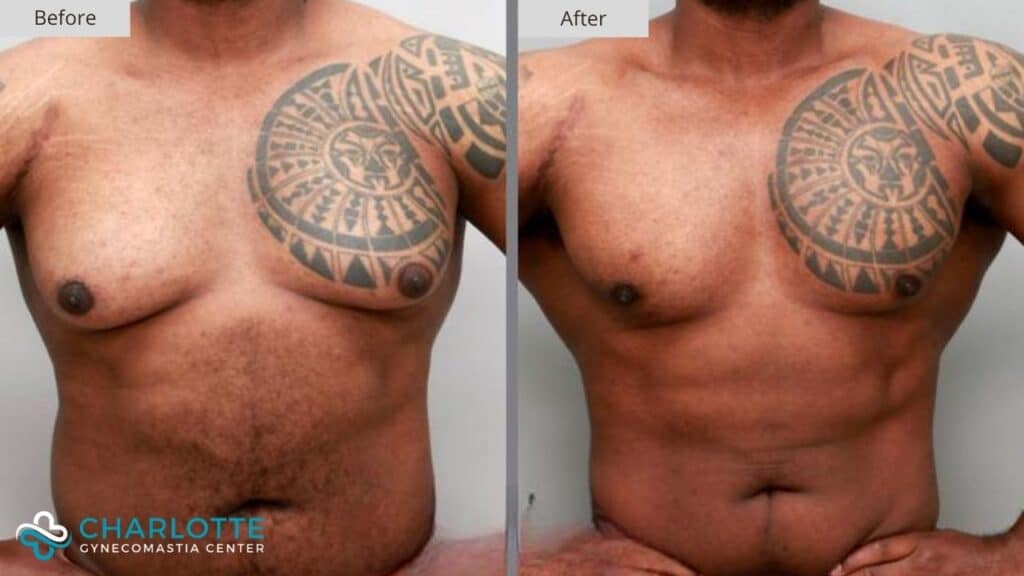
At four months after surgery, the improvement in chest shape is clearly visible. The nipples now lie flat against the chest rather than projecting outward. The lower chest appears smooth and proportionate to the upper pectoral muscles.
An important aspect of this case is the patient’s continued transformation after surgery. Since the procedure, he has lost 30 pounds, further enhancing the definition of his chest and abdomen.
The combination of surgical correction and continued weight loss allowed the chest to reflect the athletic structure underneath rather than masking it.
Scar Placement and Aesthetic Outcome
Despite the extent of correction, scarring was kept minimal. The incision was placed discreetly at the base of the areola, where it blends naturally with the transition between areolar skin and surrounding chest skin.
As healing progresses, this scar continues to soften and fade. The result is a chest that does not draw attention to surgical intervention, which allowed the focus to remain on natural contour and muscle definition.
Front, Oblique, and Flexed Views
The before and after photos include front and oblique angles, along with flexed views after surgery. These images highlight how the correction holds up not only at rest but also during muscle contraction.
When flexing, the chest maintains a smooth, masculine contour without distortion of the nipple or lower chest. This is particularly important for athletes and bodybuilders who regularly see their chest under tension.
Strength, Proportion, and Confidence Restored
This case illustrates that gynecomastia can affect men at any level of fitness. Strength alone does not resolve glandular tissue, and in some cases, it can accentuate the problem.
By combining liposuction, gland excision, and skin tightening, the procedure restored balance between muscle, skin, and chest contour. The result supports the patient’s athletic identity rather than conflicting with it.
A Chest That Finally Matches the Physique
For this former D1 football player, gynecomastia surgery was not about changing who he was. It was about allowing his chest to reflect the work he had already put into his body.
Four months after surgery, with continued weight loss and visible improvement in contour, his chest now aligns with his strength, size, and athletic presence. This outcome demonstrates how individualized planning and technique selection can deliver results that feel natural, durable, and appropriate for high performance physiques.