
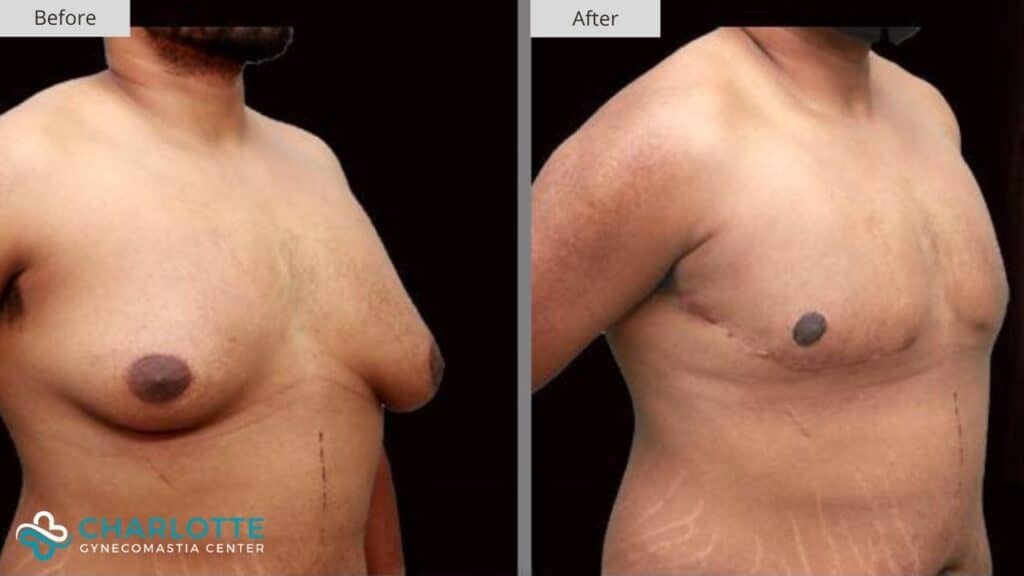
This 27 year old man came to the Charlotte Gynecomastia Center with a chest shape that had become increasingly difficult to ignore. His gynecomastia involved both fatty and glandular tissue, creating excess fullness and a noticeably hanging nipple.
The most prominent issue was nipple position. Rather than sitting along the natural border of the chest muscle, the nipple had migrated downward over time. From the front, the chest appeared heavy and bottom weighted. From the side, gravity exaggerated the droop, giving the chest a deflated appearance.
He was physically healthy, but the chest shape did not reflect his age or body composition.
Understanding Why Nipple Position Matters
Gynecomastia is not only about volume. Position plays a critical role in how the chest is perceived.
When excess fatty and glandular tissue accumulates beneath the nipple, the weight pulls the nipple downward. Even moderate fullness can distort chest proportions if the nipple falls below its natural position.
In this case, the nipple sat well below the ideal location relative to the pectoralis muscle. Correcting volume alone would not have fully addressed the issue. Restoring proportion required repositioning the nipple itself.
Evaluating Surgical Options for a Low Nipple
One option for correcting a low nipple involves detaching and grafting it into a higher position. While effective in some cases, this approach comes with tradeoffs, including changes in sensation and more visible scarring.
For this patient, a different solution was possible. By removing excess tissue and tightening the surrounding structures, the nipple could be elevated without detachment.
This approach preserves blood supply, sensation, and a more natural appearance.
A Combined Approach to Volume Reduction and Lift
The surgical plan addressed both the weight of the chest and the position of the nipple.
VASER liposuction was used to remove excess fatty tissue from the chest. A total of 1300 cc, or approximately three pounds, of fat was removed. This immediately reduced the downward pull on the nipple.
Following liposuction, glandular tissue beneath the nipple was surgically excised. Removing this dense tissue further flattened the chest and eliminated the core mass contributing to nipple projection.
Together, these steps allowed the nipple to be repositioned upward without detachment.
Nipple Repositioning Without Detachment
Once the excess tissue was removed, the nipple was elevated to a more appropriate position on the chest. In total, the nipple was moved approximately six centimeters upward.
Importantly, the nipple was not detached during this process. Preserving its connection maintains natural sensation and avoids the risks associated with grafting.
The new nipple position aligned with the natural contour of the chest muscle, restoring balanced proportions.
Incision Placement and Scar Management
Scarring was carefully planned to remain discreet. The primary incision was hidden in the crease beneath and along the side of the chest muscle, where shadows and natural folds help conceal healing lines.
There were no visible scars across the center of the chest and no incisions placed directly through the nipple itself.
As healing progresses, these scars continue to soften and blend with surrounding skin.
Early Healing and Visible Changes
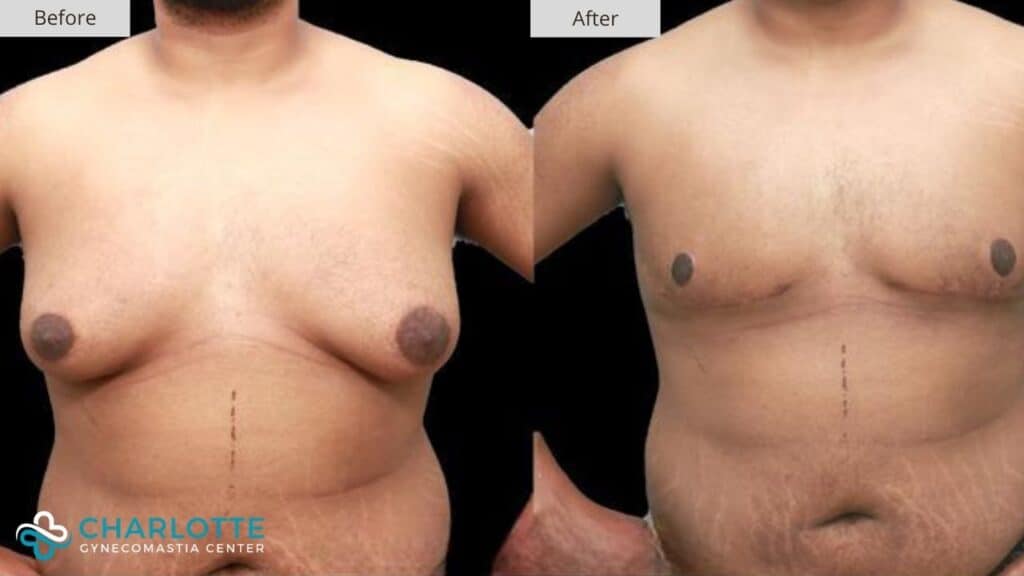
Even early in the recovery process, the improvement in chest shape was apparent. The chest appeared flatter and more evenly distributed. The nipple sat higher and no longer pointed downward.
The hanging appearance seen before surgery was resolved. Instead, the chest took on a more proportionate profile.
As swelling continued to subside, the new contour became more refined.
Viewing the Chest From Multiple Angles
The before and after images show the transformation clearly from front and side views. From the side, the chest no longer droops. From the front, the nipple position appears balanced and centered relative to the chest muscle.
The transition from upper chest to lower chest is smoother, without excess fullness collecting beneath the nipple.
These changes significantly alter how the chest is perceived, even without extreme changes in overall size.
Why This Approach Preserves Natural Appearance
By avoiding nipple detachment and focusing on structural correction, the result remains natural. The nipple retains its normal characteristics. The chest moves and behaves like an untreated chest rather than a reconstructed one.
This approach works best when nipple descent is driven by tissue weight rather than severe skin excess. In this patient, removing the underlying cause allowed the anatomy to reset appropriately.
Long Term Expectations and Durability
With the fatty and glandular tissue removed, the forces that caused nipple descent are gone. As long as weight remains stable, the new chest contour is expected to be durable.
Since the nipple was not grafted, long term sensation and appearance are preserved. The scars remain hidden, allowing the chest to appear untreated to casual observers.
Restoring Balance Without Overcorrection
This case highlights how thoughtful surgical planning can correct significant chest distortion without aggressive measures. Rather than detaching and relocating the nipple, the solution addressed the underlying anatomy.
By removing excess tissue, elevating the nipple into its natural position, and hiding scars within natural creases, the chest was restored to a masculine shape. For this 27 year old man, the result is a chest that looks proportionate, natural, and appropriate for his age and body.