
This young man presented to the Charlotte Gynecomastia Center after a remarkable personal achievement. Through sustained effort and lifestyle changes, he voluntarily lost approximately 100 pounds. While the weight loss significantly improved his overall health, it also revealed a new challenge that could not be resolved through exercise or time.
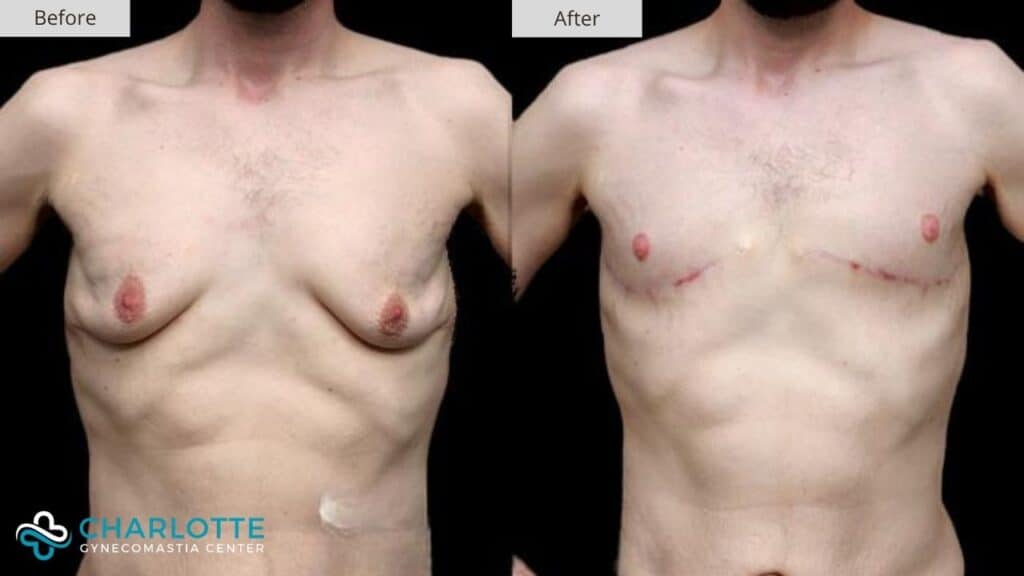
Rather than excess glandular breast tissue, his primary concern was the appearance of his chest following the weight loss. The skin had stretched during years of higher body weight and did not regain its elasticity afterward. This resulted in visible sagging, a deflated chest contour, and nipples that sat noticeably lower on the chest wall.
Although many men assume this appearance is gynecomastia, this case represented a post–weight loss chest deformity, which requires a very different surgical approach.
Why This Was Not Traditional Gynecomastia
Gynecomastia typically involves excess glandular tissue beneath the nipple. In this patient, the issue was not tissue volume but skin behavior. After losing a large amount of weight, the skin envelope remained oversized compared to the underlying chest musculature.
Several characteristics distinguished this case from classic gynecomastia:
- Minimal glandular tissue remaining after weight loss
- Significant skin laxity across the lower chest
- Nipples displaced downward and forward
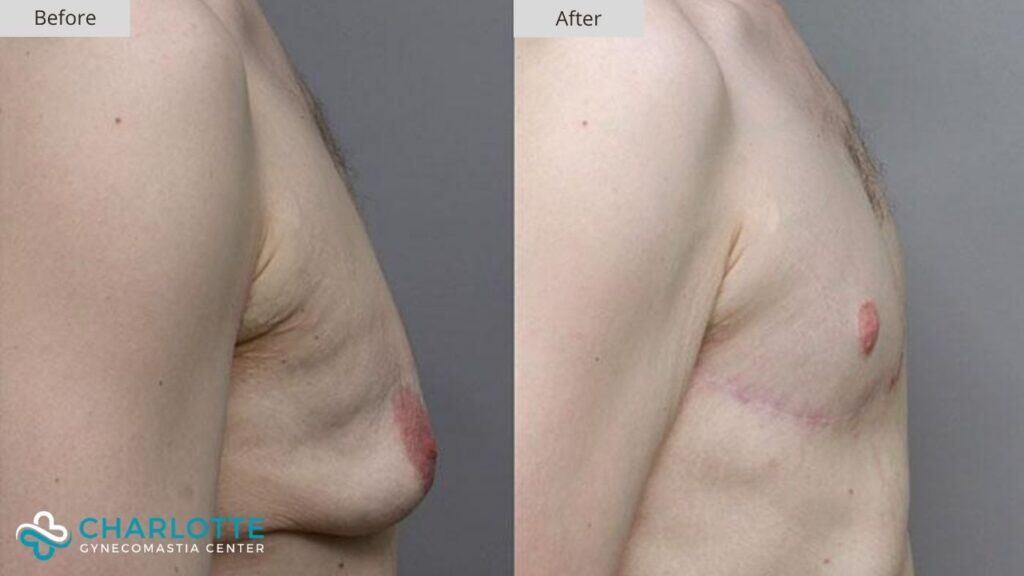
- A hanging appearance when viewed from the side
Liposuction or gland excision alone would not have corrected these issues. In fact, those techniques could have worsened the deflated appearance. A reconstructive strategy focused on reshaping and repositioning was necessary to achieve a natural result.
Surgical Planning and Goals
The primary goal was to restore a masculine chest contour that matched the patient’s new body proportions. This required careful planning to address both excess skin removal and nipple placement.
Key surgical objectives included:
- Removing loose, redundant chest skin
- Creating a flatter, firmer chest profile
- Repositioning the nipples to a more natural location
- Placing scars where they would be least noticeable over time
Since the nipples were significantly displaced, a standard repositioning technique was not sufficient. A free nipple graft approach was selected to allow precise placement without tension.
The Procedure and Surgical Technique
The procedure focused on reshaping the chest rather than removing tissue volume. Excess skin was excised to tighten the chest envelope and restore definition. The nipple–areola complexes were removed and carefully preserved during the process.
Once the chest skin was tightened and contoured, the nipples were grafted into a more anatomically appropriate position. This allowed for proper alignment with the underlying pectoral muscles and a more natural chest appearance.
The incision was placed within the natural crease beneath the chest muscle, an area that typically heals well and becomes less noticeable over time. This placement is especially important in post–weight loss patients, where scar visibility is a common concern.
Early Recovery and Healing Progress
At four months after surgery, the patient was well into the healing phase. The chest contour showed a significant improvement compared to the preoperative appearance. The excess skin was gone, the chest appeared flatter and firmer, and the nipples were positioned higher and more centrally.
At this stage, the scar remained pink, which is expected during early healing. Importantly, the scar followed the natural chest crease, allowing it to blend with normal anatomy as maturation continues.
Other early observations included:
- Improved chest symmetry
- Better definition of the upper chest
- A more proportionate relationship between chest and torso
Swelling had largely resolved by this point, allowing the true shape of the chest to become visible.
Visual Changes and Overall Outcome
From the side view, the chest no longer appeared droopy or deflated. From the front, the nipples sat in a more balanced and masculine position. The overall result reflected a chest that aligned with the patient’s weight loss success rather than detracting from it.
This transformation was not about creating an exaggerated or sculpted appearance. The goal was normalization, restoring a chest that looked appropriate for his frame and age.
The outcome demonstrates how proper surgical planning can address concerns that are often misunderstood or misclassified.
Why Specialized Experience Matters
Post–weight loss chest reshaping is fundamentally different from treating gynecomastia. Skin quality, nipple position, and scar placement all play a larger role in determining success. Attempting to treat these cases with standard gynecomastia techniques can lead to under correction or poor contour.
This case highlights the importance of:
- Correct diagnosis
- Customized surgical planning
- Experience with reconstructive male chest procedures
By focusing on the underlying cause rather than the label, the surgical approach delivered a result that fit the patient’s anatomy and goals.
Final Thoughts
This patient’s outcome reflects the value of addressing male chest concerns with precision and honesty. Not every enlarged or sagging chest is gynecomastia, and recognizing that difference is critical to achieving natural results.
Four months after surgery, healing was progressing as expected, scar placement was appropriate, and the chest contour had been fundamentally restored. As scar maturation continues, the final result will continue to refine, further supporting the long-term success of the procedure.
This case serves as an example of how the Charlotte Gynecomastia Center approaches complex chest concerns with individualized care, especially for men who have worked hard to transform their bodies and want their results to reflect that effort.