
This 32 year old man came to the Charlotte Gynecomastia Center with a longstanding concern about the shape of his chest. Despite maintaining an active lifestyle and athletic build, his chest had a rounded appearance that did not respond to training or body fat changes.
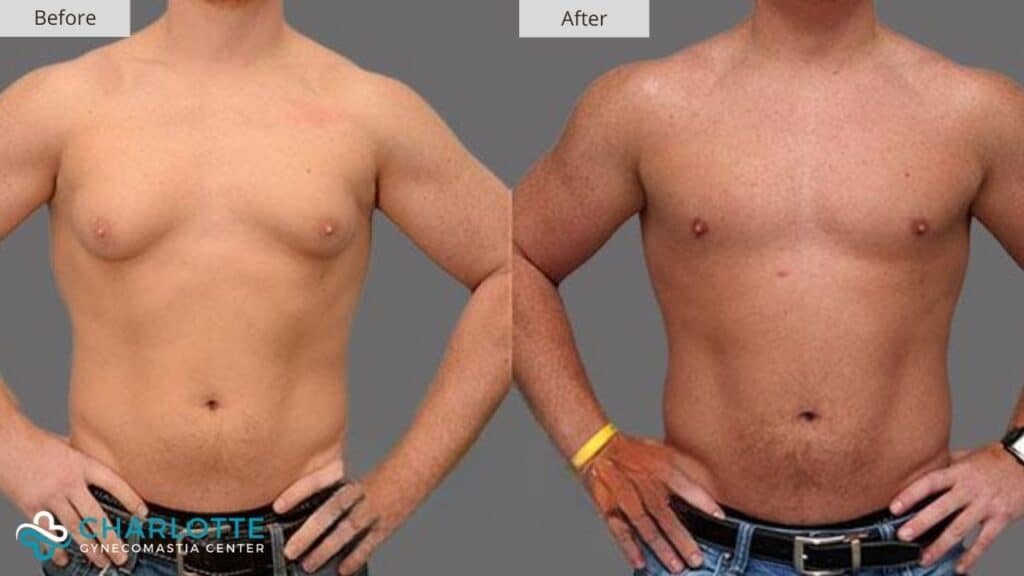
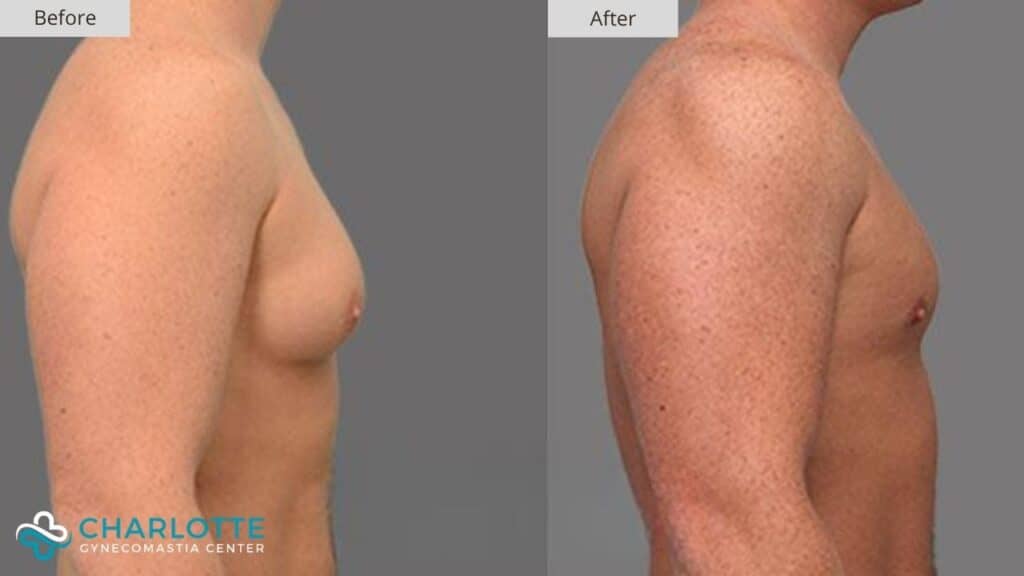
The most noticeable feature was the projection directly beneath the nipples. From both the front and side, the nipples pushed outward, creating a contour more consistent with a female breast shape than a masculine chest. This appearance persisted regardless of weight or conditioning.
He reported prior use of pro hormones and gym supplements, which is an important detail in understanding the cause of his condition.
Understanding Supplement Related Gynecomastia
Certain supplements and hormone altering substances can stimulate the growth of male breast gland tissue. Unlike fatty tissue, this glandular growth is dense and firm. Patients often describe it as hard, rubbery, or scar like in texture.
In this patient, the glandular tissue sat directly beneath the nipple. Due to its density and location, it created a round contour and nipple projection that could not be flattened through exercise or fat loss.
This type of gynecomastia behaves differently than weight related fullness. Liposuction alone is not sufficient. The tissue must be physically removed to correct the shape.
Why Exercise Made No Difference
Many men with supplement induced gynecomastia believe that building more muscle will eventually correct the problem. In reality, increased pectoral muscle mass can make glandular gynecomastia more noticeable.
As the muscle develops underneath, the firm gland is pushed forward. This exaggerates nipple projection rather than flattening it. That dynamic was clearly present in this case.
The issue was not overall chest size. It was the presence of a concentrated mass of glandular tissue that disrupted normal chest contour.
Surgical Goals and Priorities
The primary goal was to eliminate nipple projection and restore a flat, athletic chest profile. Precision was essential. Removing the gland without over resection would allow the chest to look natural rather than hollow.
Key priorities included:
- Complete removal of dense glandular tissue
- Preservation of surrounding fat for smooth contour
- Minimal scarring
- Immediate visual improvement
Since the problem was localized directly under the nipple, a focused surgical approach was appropriate.
Surgical Technique and Incision Placement
The procedure was performed using a hidden incision placed within the pigmented areolar tissue surrounding the nipple. This location provides excellent access to the gland while allowing scars to blend naturally with the areola.
Through this incision, the dense glandular tissue was carefully dissected and removed. The tissue had the characteristic firm, gristle like quality commonly seen in hormone related gynecomastia.
Care was taken to preserve an appropriate layer of tissue beneath the nipple to maintain a smooth contour and avoid depression.
Since the primary issue was glandular rather than fatty tissue, liposuction played a limited role. Direct excision was the key corrective step.
Immediate Contour Restoration
One of the defining aspects of this case was the immediacy of the result. Once the glandular tissue was removed, the chest flattened immediately. The nipple no longer projected outward and the rounded appearance resolved.
The chest assumed a more athletic contour that aligned with the rest of his physique. This type of immediate change is typical when dense glandular tissue is the primary cause of gynecomastia.
Unlike cases involving skin tightening or fat redistribution, the correction here was structural and direct.
Recovery and Early Healing
Following surgery, the patient entered a standard recovery period. Swelling was present, as expected, but the underlying shape was already evident.
Since the incision was confined to the areola, visible scarring was minimal. As healing progressed, the incision blended into the natural color variation of the nipple area.
There were no long incisions across the chest and no disruption to surrounding anatomy. This allowed for a relatively straightforward recovery and early return to normal activities.
Visual Outcome From Multiple Angles
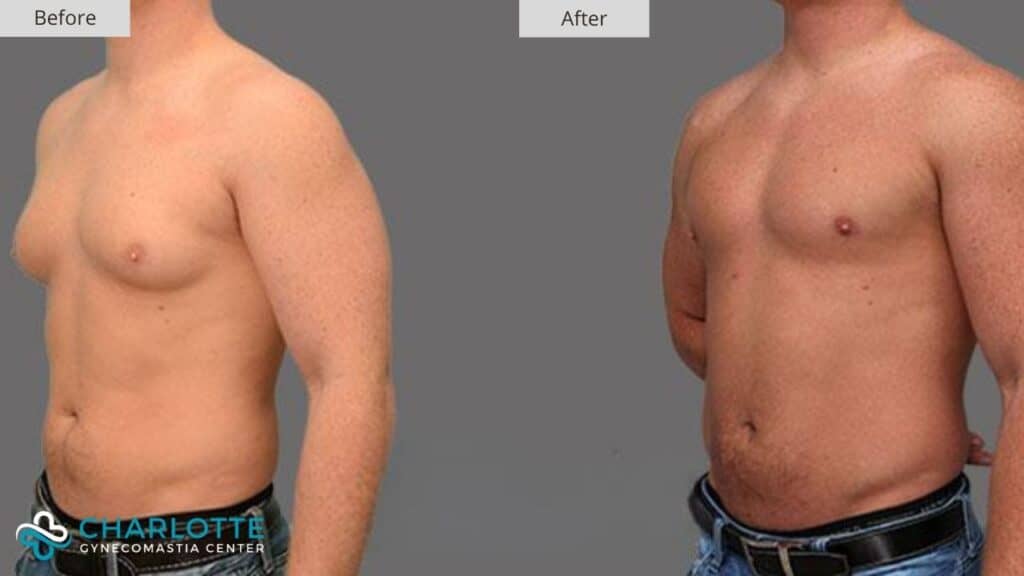
The before and after images include front and side views, clearly demonstrating the change in chest shape. From the side, the nipple projection seen before surgery is no longer present. From the front, the chest appears flatter and more proportionate.
The contour transitions smoothly from the upper chest into the lower chest without irregularities. The result reflects the underlying muscle structure rather than being dominated by glandular bulk.
This type of correction is particularly satisfying for patients who have trained consistently but never saw improvement in chest shape.
Addressing the Root Cause Matters
This case highlights the importance of identifying the cause of gynecomastia rather than treating all cases the same way. Supplement induced gynecomastia behaves differently than weight related or pubertal forms.
Attempting to treat dense glandular tissue with liposuction alone would have left the core problem untouched. Direct excision was necessary to resolve the nipple projection and rounded contour.
Understanding the source of the tissue allowed for a targeted and effective solution.
A Chest Restored to a Natural Athletic Shape
For this patient, correction was not about subtle refinement. It was about removing a distinct abnormality that altered how his chest looked and felt.
Once the glandular tissue was removed, the chest immediately returned to a more natural masculine shape. The result aligned with his age, activity level, and physique without introducing visible scars or unnecessary intervention.
This case demonstrates how precise diagnosis and focused surgical technique can deliver clear and lasting results, particularly when gynecomastia is driven by hormone altering substances.