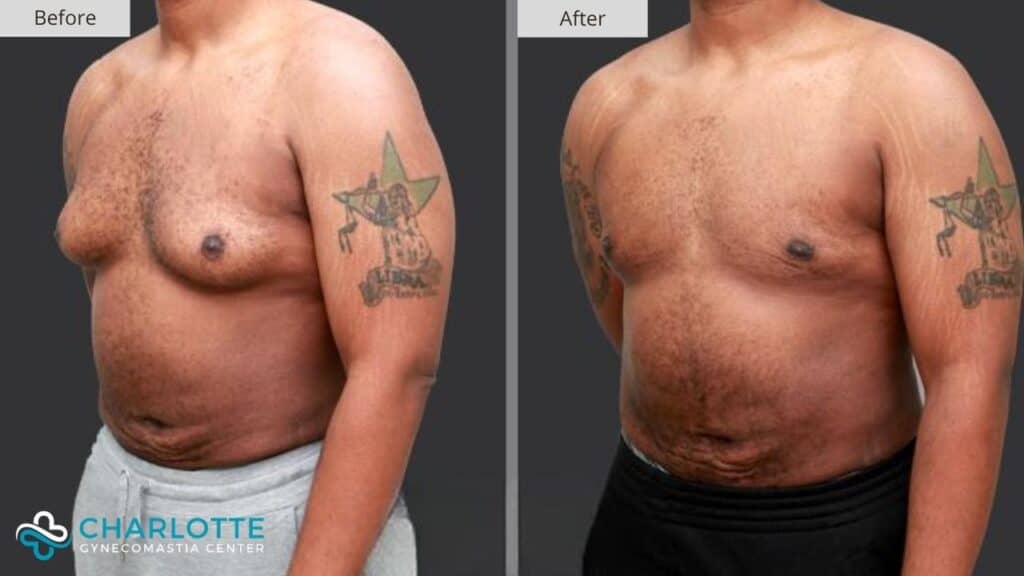
This 39 year old man came to the Charlotte Gynecomastia Center after losing approximately 84 pounds. His weight loss significantly changed his body composition, but his chest did not fully adapt to the transformation.
Although his overall frame became leaner, excess breast tissue remained. In addition, the skin around the nipple area appeared loose and slightly sagging. From the front, the chest looked fuller than expected. From the side, the skin lacked the firmness needed to create a flat, athletic contour.
He was pleased with his weight loss progress but concerned that his chest still reflected his former weight.
Identifying a Mixed Gynecomastia Pattern
This case involved more than one contributing factor. The patient had true gynecomastia with excess breast tissue, along with residual fatty tissue and skin laxity after significant weight loss.
The challenge was finding a solution that addressed all three issues without creating large visible scars. Traditional skin excision techniques would have corrected the looseness but would also leave a long incision across the chest.
The patient was clear about his priorities. He wanted meaningful improvement without trading one aesthetic concern for another.
Evaluating Surgical Options Without Large Incisions
Several treatment approaches were considered. Removing skin surgically would predictably tighten the chest, but the resulting scars would be permanent and highly visible.
Given the amount of weight loss and remaining skin quality, a scar minimizing approach was reasonable. Advances in energy based skin tightening made it possible to address skin laxity internally rather than cutting it out.
This allowed for a more refined plan that combined tissue removal and skin contraction.
A Combined Approach for Contour and Tightening
The surgical plan involved three complementary steps designed to work together.
VASER liposuction was performed on the anterior and lateral chest to remove excess fatty tissue. A total of approximately 1200 cc of fat was removed, allowing the chest to taper naturally into the surrounding torso.
Direct surgical excision addressed the glandular breast tissue that contributed to nipple fullness and projection. Removing this tissue helped flatten the central chest.
Renuvion was then applied to tighten the skin internally. This step was critical for improving skin quality without external scars.
Details of Renuvion Application
Renuvion was used at 90 percent energy, with 1.5 liters per minute of helium, applied for 33 inches of treatment path. This delivered approximately 23 kilojoules of energy to the chest.
This controlled energy causes the tissue beneath the skin to contract while promoting long term tightening as healing progresses. Unlike surgical excision, the tightening effect develops gradually, allowing the skin to adapt naturally to the new contour.
Early Healing and Visible Improvement
As swelling subsided, the chest began to show a flatter and firmer appearance. The fullness around the nipple area decreased, and the skin gradually conformed to the underlying muscle.
Although the skin was not surgically removed, the tightening effect was sufficient to avoid the sagging appearance seen before surgery. The chest looked more proportionate to his slimmer frame.
The absence of long incisions allowed healing to focus on contour rather than scar management.
Scar Placement and Aesthetic Considerations
All access points for the procedure were kept small and discreet. There were no horizontal scars across the chest. Any incisions used for tissue removal were minimal and designed to blend with natural skin features.
This approach respected the patient’s desire to avoid visible reminders of surgery while still delivering a meaningful transformation.
Viewing the Results From Multiple Angles
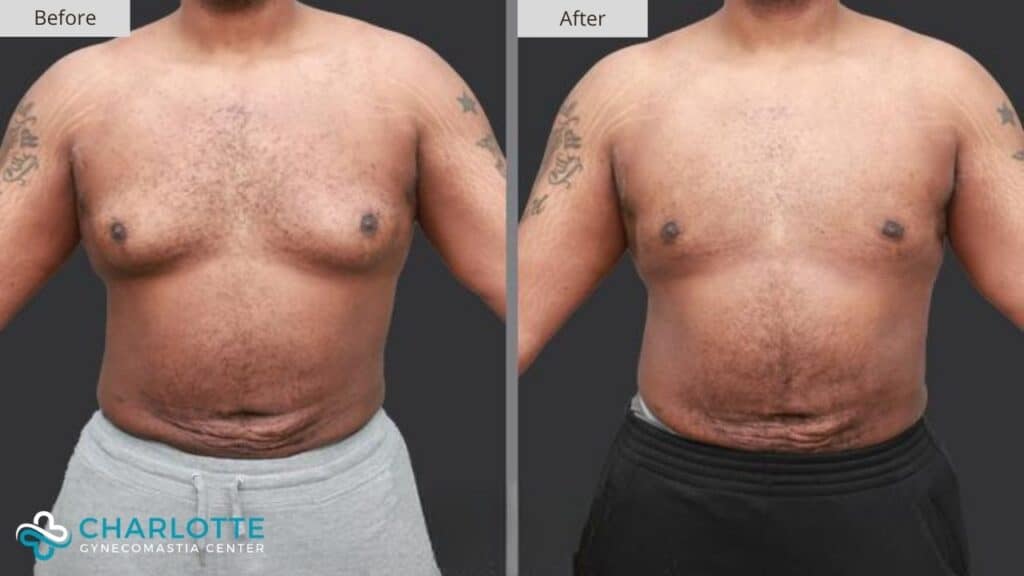
The before and after images include front and oblique views, showing improvement in both projection and skin quality. From the side, the chest no longer appears heavy or drooping. From the front, the nipple area lies flatter against the chest.
The contour transition from the upper chest to the lower chest appears smoother and more natural. The lateral chest also benefits from liposuction, contributing to a more athletic silhouette.
When Energy Based Tightening Makes Sense
This case demonstrates when Renuvion can be an effective alternative to skin excision. In patients with moderate skin laxity and a strong preference to avoid scars, internal tightening can produce reliable improvement.
It is not a substitute for skin removal in all cases. In patients with extreme skin excess, excision remains necessary. However, for carefully selected individuals, this technology expands the range of options available.
Balancing Correction With Scar Avoidance
For this patient, the goal was balance. Correcting gynecomastia and loose skin without creating new aesthetic concerns required a thoughtful combination of techniques.
By pairing VASER liposuction, direct gland excision, and Renuvion skin tightening, the chest was reshaped without long scars. The result reflects his weight loss progress while preserving a natural appearance.
This case highlights how modern techniques can be tailored to patient priorities, especially when scar avoidance plays a central role in decision making.